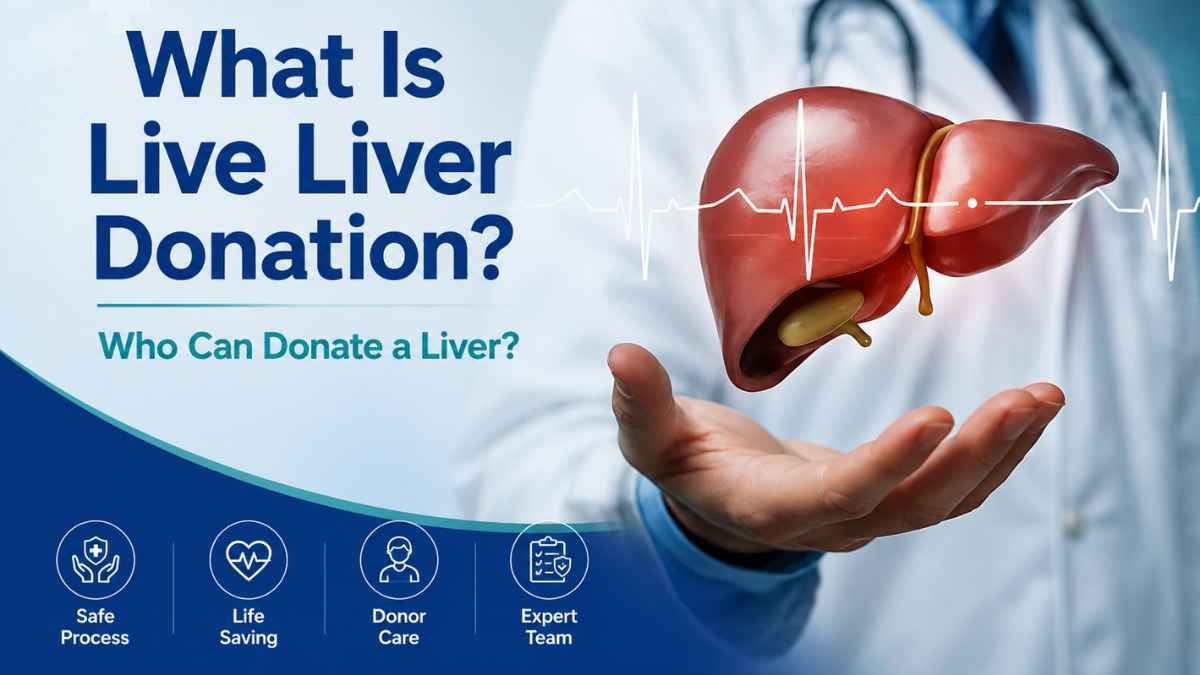
A live liver donation is a type of liver transplant in which a healthy person donates a part of their liver to a patient whose liver is no longer functioning adequately. Unlike deceased-donor transplantation, the donation takes place while the donor is alive and medically fit for the procedure.
The liver has a unique ability to regenerate. After donation, the remaining liver in the donor and the transplanted portion in the recipient gradually increase in size and function. However, living liver donation is a major surgical procedure and requires detailed medical, psychological and legal evaluation before a person can be accepted as a donor.
Who can donate liver?
Not everyone can become a living liver donor. The donor must meet specific health, age, relationship and anatomical requirements.
Generally, potential donors are adults within an appropriate age range, often around 18–55 years, although the final decision depends on the transplant centre's assessment. The donor should be in good overall health and should not have conditions that could significantly increase the risks of surgery or affect the donated liver.
Body weight is also considered during donor evaluation. A very high body mass index (BMI) may increase surgical risks and can sometimes be associated with fatty liver. Therefore, the donor's height, weight and liver health are carefully assessed.
Does blood group need to match?
Blood-group compatibility is an important part of living liver donation. In conventional blood-group matching:
- A blood-group recipients can generally receive from A or O donors.
- B recipients can generally receive from B or O donors.
- O recipients generally require an O-group donor.
- AB recipients can generally receive from A, B, AB or O donors.
However, a blood-group mismatch does not always mean that liver transplantation is impossible. In selected situations, ABO-incompatible liver transplantation may be considered with specialised medical protocols.
Paired or swap donation may also be an option in certain circumstances, where two donor-recipient pairs are individually incompatible but can potentially exchange donors. Such arrangements are subject to medical suitability and applicable legal and regulatory requirements.
Does the donor have to be a family member?
Living liver donation is regulated by law, and donor eligibility depends on the applicable transplantation regulations and approval process.
In India, donation from certain near relatives may be permitted after the required evaluation and authorisation. Donation by an unrelated person is subject to specific legal requirements and scrutiny.
Therefore, a person should never assume that being willing to donate automatically makes them eligible. The transplant team and the appropriate authority assess the donor-recipient relationship, consent and other legal requirements before transplantation.
What tests are done before liver donation?
Once a potential donor meets the initial requirements, a comprehensive evaluation is performed. The assessment has two major objectives: to protect the donor and to ensure that the donated liver will be suitable for the recipient.
The evaluation may include:
- Detailed medical history and physical examination
- Blood investigations
- Heart and lung assessment
- Screening for infections
- Liver function assessment
- Imaging studies such as CT scans
- Assessment of liver size and volume
- Evaluation of liver blood vessels and bile ducts
- Psychological and counselling assessment
A CT scan can provide important information about the liver's anatomy, blood vessels and volume. The transplant team calculates whether enough liver can safely remain with the donor and whether the portion being donated will provide adequate liver mass for the recipient.
If any significant health problem or anatomical concern is identified, the person may not be accepted as a donor. Donor safety remains the first priority.
What happens during living liver donation?
After the donor is medically and legally cleared, the surgery is planned by the transplant team. The operation is a major procedure and may take several hours.
Only a suitable portion of the donor's liver is removed and transplanted into the recipient. The donor is monitored closely after surgery, and the hospital stay varies depending on recovery and individual circumstances.
Like any major operation, liver donation can have risks. Some donors may experience pain, nausea, vomiting or other temporary problems during recovery. More serious complications are uncommon but can include bleeding, bile-related complications, infection and other surgical complications.
This is why living liver donation should only be considered after a thorough discussion with an experienced transplant team.
Does the liver grow back after donation?
One of the most remarkable features of the liver is its regenerative capacity. Following living liver donation, the remaining liver in the donor adapts and increases in volume and function. Similarly, the transplanted liver portion grows within the recipient.
Recovery and regeneration vary between individuals and depend on several factors, including the amount of liver donated, the donor's health and the recipient's condition. The transplant team monitors both donor and recipient through follow-up assessments.
Choosing a liver transplant surgeon
Living liver donation involves two patients — the donor and the recipient — so the decision requires careful planning and specialised expertise.
If you are considering living liver donation for a family member, speak with a qualified transplant team before making any decision. A Liver Transplant Surgeon in Gurgaon can assess the donor and recipient, explain the potential benefits and risks, and guide the family through the medical and legal process.
Dr. Sanjay Kumar Yadav is a ">Hepato-Pancreatic-Biliary and Liver Transplant Surgeon in Gurgaon, with qualifications including MS (AIIMS) and Fellowship in Hepatobiliary & Liver Transplantation. He is a Senior Consultant Surgeon at Gutwell and Narayana Hospital, Gurgaon, and has extensive experience in complex liver transplantation, including living-donor liver transplant surgery.
Disclaimer: This content is for general educational purposes only and is not a substitute for professional medical advice, diagnosis, or treatment. Please consult a qualified doctor about your individual condition. No specific outcome is guaranteed.