Gutwell Clinics, Gurugram OPD: Mon, Wed, Fri & Sat, 4:00 PM – 6:00 PM
Outstation & video consults available WhatsApp +91 90000 00000
Home  /  Liver Transplant  /  Donor Evaluation
Donor eligibility & evaluation

Liver Donor Eligibility & Evaluation

Clear, legal and honest information about who can donate part of their liver — and how donor safety is protected.

A legal & ethical commitment: Under the Transplantation of Human Organs and Tissues Act (THOTA), living liver donation is permitted only for genuine near-relatives acting as voluntary donors, with formal authorisation. Buying, selling or soliciting organs is a serious crime. This page is purely educational — we never source, arrange or facilitate donors.
Living donation basics

Who can donate part of their liver?

A near-relative

Parents, children, siblings, spouse and grandparents may donate, as permitted by law — always as genuine volunteers.

In good health

Generally 18–55 years, with a healthy liver, suitable anatomy and no major medical conditions.

Compatible or manageable blood group

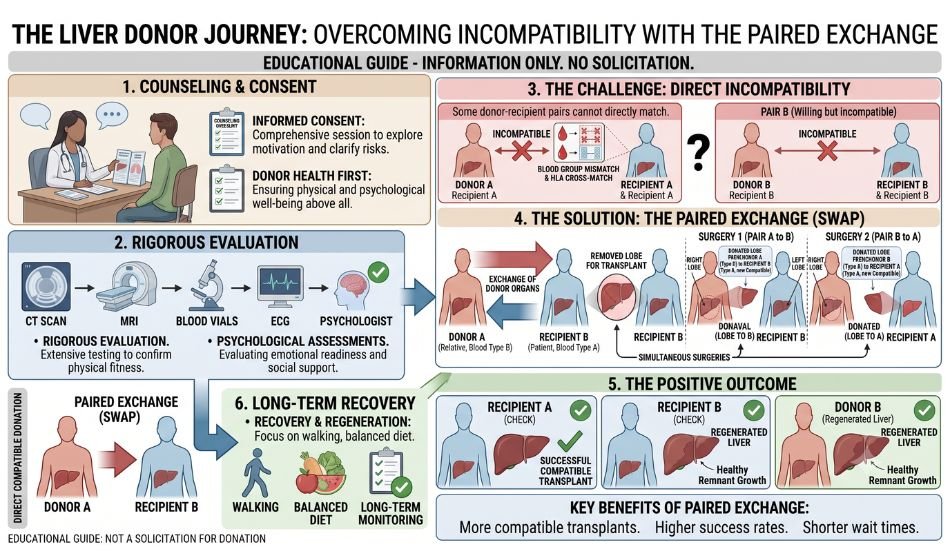
Matched blood groups are ideal; ABO-incompatible and swap options can help when they differ.

The evaluation

How donor safety is assessed

A potential donor is never rushed. Evaluation is designed to protect the donor first.

Voluntary consent & counselling

Confirming the donor is a willing volunteer who understands the process, with no pressure of any kind.

Health & blood tests

General health check, liver function and infection screening to confirm the donor is fit.

Liver imaging

Scans to assess the liver's size, volume and blood-vessel anatomy, ensuring enough healthy liver remains for the donor.

Committee approval

Formal authorisation by the hospital's transplant committee, as required by law, before anything proceeds.

Deceased donation

The gift of deceased (brain-death) donation

Not every family has a suitable living donor. Donation after brain death — through the government's regulated programme — saves many lives every year, and one donor can help several patients. Raising awareness of deceased donation is something Dr. Yadav strongly supports, always within the legal framework.

  • Regulated by government organ & tissue transplant bodies
  • Allocated fairly by urgency, blood group and waiting time
  • A profound act of generosity — never bought or sold
Answers for families

Donor questions, answered honestly

Only near-relatives — such as parents, children, siblings, spouse and grandparents — may donate as living donors under Indian law. Every donor must be a genuine volunteer, in good health, and is thoroughly evaluated to confirm donation is safe for them.

A potential donor undergoes blood tests, imaging of the liver (to check size and anatomy), assessment of general health, and counselling. The goal is to confirm the donor is healthy and that donating is safe for them before anything proceeds.

The liver regenerates, so a healthy donor's liver grows back to near-normal size within weeks, and donors generally return to a completely normal life. Donors are selected only after evaluation confirms it is safe. The team explains all risks honestly.

Donating to a near-relative, as a genuine volunteer, is legal and requires formal approval. Paying for an organ, or receiving payment to donate, is strictly illegal. This clinic never arranges, sources or facilitates paid donors in any form.

Have questions about donating for a loved one?

Speak with Dr. Yadav's team for clear, legal and compassionate guidance about the evaluation process.

Chat on WhatsApp Call +91 90000 00000
Call WhatsApp Book OPD