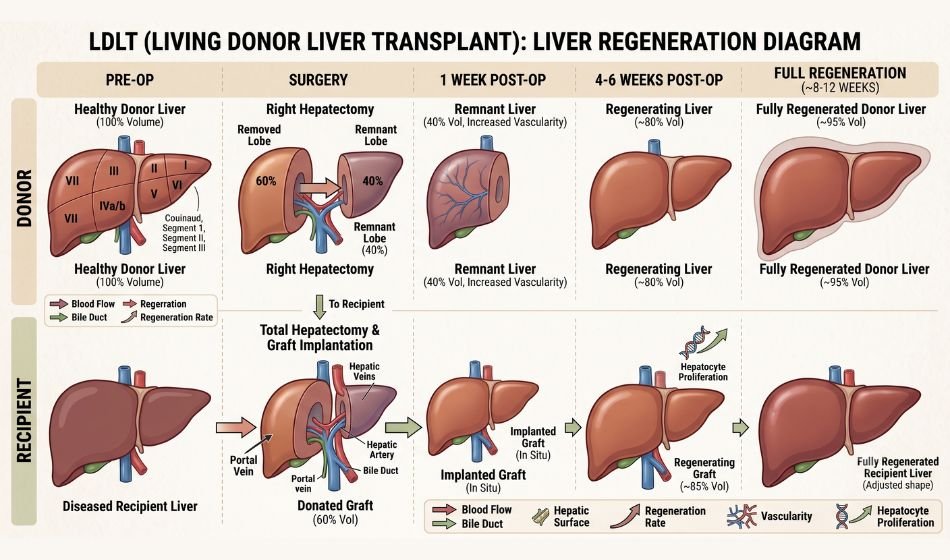
In a living donor liver transplant (LDLT), a healthy family member (a near-relative) donates a portion of their liver to the patient. Because the liver is the only organ that regenerates, both the donor's remaining liver and the transplanted portion grow back to near-normal size within a few weeks.
LDLT is the most common form of liver transplant in India, largely because deceased-donor organs are limited. It allows the surgery to be planned in advance rather than waiting for an emergency organ.
Who can be a living liver donor?
Under Indian law, living liver donation is permitted only for near-relatives (such as parents, children, siblings, spouse and grandparents). Every potential donor undergoes a thorough evaluation to confirm that donating is safe for them. A donor is generally expected to be:
- A willing near-relative, typically between 18 and 55 years of age
- In good general health, with a healthy liver and compatible (or manageable) blood group
- Free of significant medical conditions that would make donation unsafe
How the LDLT procedure works
The donor and recipient surgeries happen in parallel, by an experienced team. The healthy liver portion is removed from the donor and transplanted into the patient, connecting blood vessels and bile ducts with precision. Donor safety is the first priority throughout.
Recovery after LDLT
- Donor: usually discharged within about a week; liver regenerates over a few weeks; most return to normal life and work within 4–8 weeks.
- Recipient: ICU care followed by a ward stay; medications to prevent rejection; a structured diet and follow-up plan. Recovery timelines vary by individual.