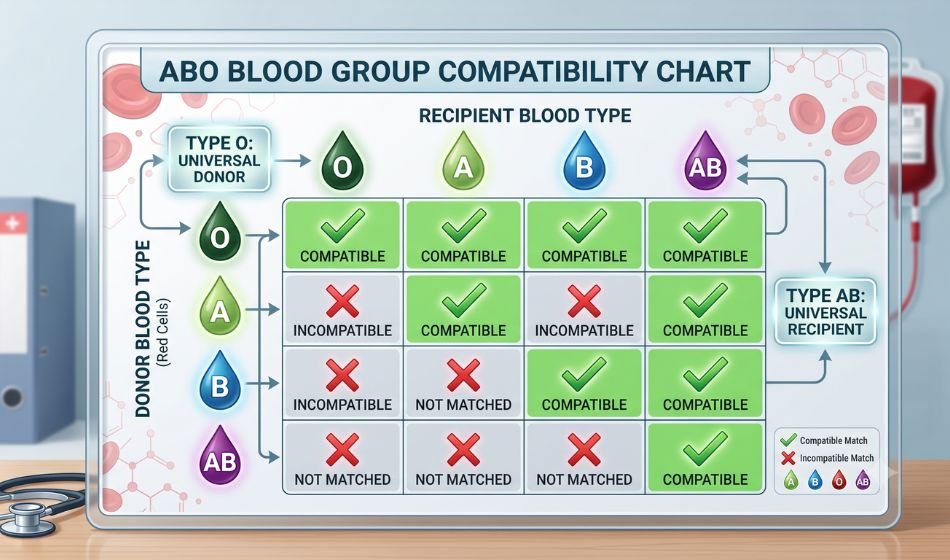
Traditionally, a liver donor and recipient needed compatible blood groups. An ABO-incompatible liver transplant (ABOi) changes that — using special preparation, a transplant can now succeed even when the blood groups differ. For many families, this means a willing family donor who was previously “ruled out” can now help.
Why ABO-incompatible transplant matters
When a patient urgently needs a transplant and the only willing near-relative donor has a mismatched blood group, ABOi can be life-saving. It widens the donor pool and reduces waiting time, particularly valuable in a country where deceased-donor organs are scarce.
How does it work?
Before surgery, the recipient undergoes a preparation protocol to safely lower the antibodies that would otherwise react against the mismatched blood group. This is done carefully over a planned period, followed by the transplant itself. ABOi requires experience and precise planning — which is why it should be done by seasoned transplant teams.
Is it as safe as a matched transplant?
With modern protocols and an experienced team, ABO-incompatible transplants have become a well-accepted option with good outcomes. As with any transplant, suitability is decided case by case after full evaluation, and the team explains the individual risks and benefits honestly.