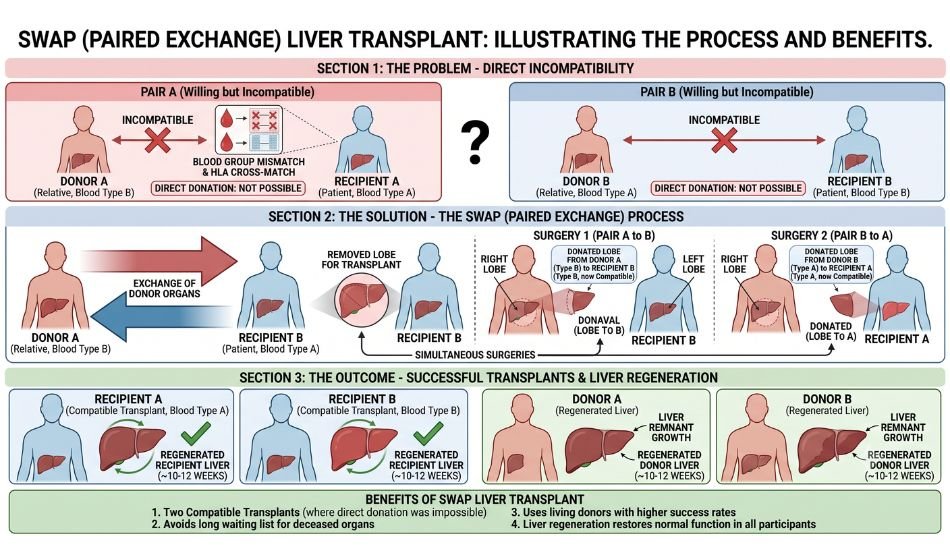
Sometimes a family has a willing near-relative donor, but the donor isn't a match for their own patient (for example, due to blood group). A swap (paired-exchange) liver transplant solves this: two such families are matched so that each donor gives to the other family's patient, where they are compatible. Both patients receive a transplant that would otherwise not have been possible.
How a liver swap works
- Family A has a willing donor who doesn't match patient A, but matches patient B.
- Family B has a willing donor who doesn't match patient B, but matches patient A.
- With legal approval, the donors are “swapped” so both patients get a compatible transplant.
Strictly regulated: Swap transplants are permitted only between genuine
near-relative donor–recipient pairs and require formal approval from the authorisation committee. This is an
educational explanation only — no organ is ever bought, sold or brokered.
When is a swap considered?
A swap is considered when a family has a willing donor who is medically fit but incompatible with their own patient, and a suitable matching pair is available. It is one more way an experienced transplant program can help families who might otherwise run out of options — alongside ABO-incompatible transplant.